Blog · Calculus guides · 16 October 2026 · 4 min read
Chain Rule: Steps, Examples & Practice Problems
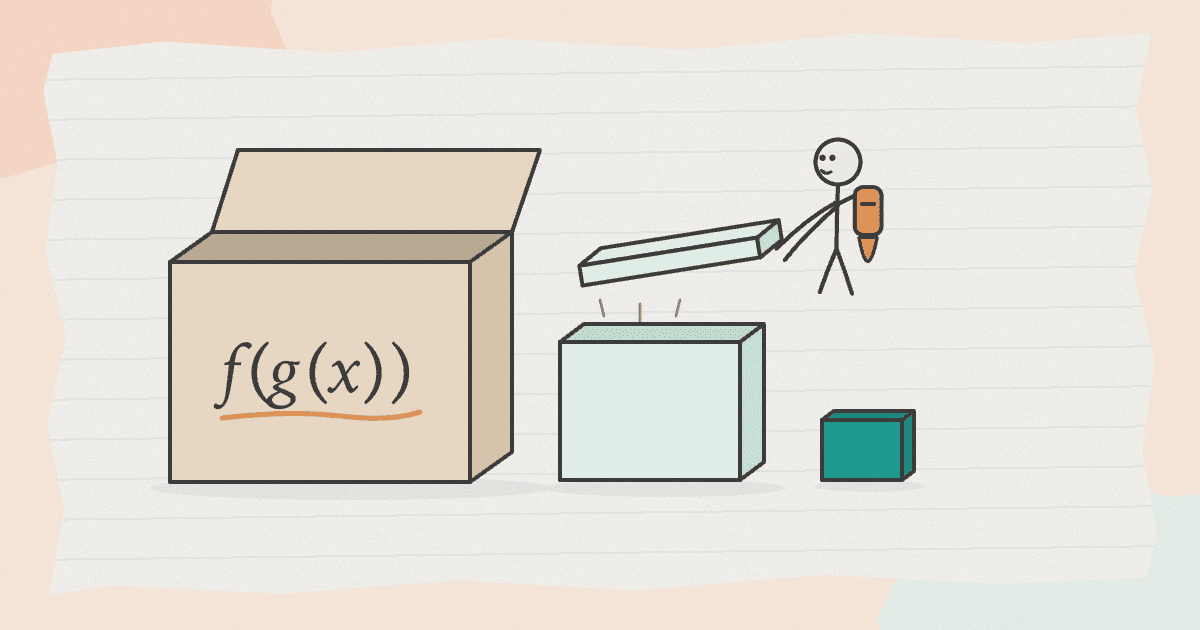
The chain rule differentiates a function inside another function: . Differentiate the outside function and leave the inside alone, then multiply by the derivative of the inside. For example, .
The formula
Same rule, two outfits. The second one, in Leibniz notation, is the one that makes it look like the 's cancel. They don't really, but it is a very good way to remember it.
When to use it
Use the chain rule whenever something other than plain is sitting where the should be: a bracket raised to a power, of something, to the something, of something, a square root of anything longer than . A quick test: if you would have to work out the inside first on a calculator before applying the outer function, it is a composition, and it needs the chain rule. In practice that is most derivatives you will ever meet, which is why it is worth getting automatic.
How to do it, step by step
- Spot the layers. Name the outside function and the inside function . In the outside is "something to the fifth" and the inside is .
- Differentiate the outside, keeping the inside as it is. Treat the inside as one lump: , so you write . Do not touch what is inside the bracket yet.
- Multiply by the derivative of the inside. Here . This is the step everyone forgets, and it is the whole rule.
- Repeat for every extra layer, then tidy up. If the inside has its own inside, keep going outward-in, one factor per layer. Then collect the constants at the front.
Worked examples
Example 1: A bracket to a power
EasyDifferentiate:
Outside: , whose derivative is . Inside: , whose derivative is .
Multiply the constants together and put them at the front.
Answer
Example 2: Trig of a polynomial
MediumDifferentiate:
Outside: , whose derivative is . Inside: , whose derivative is .
Note the inside stays exactly as it was inside the cosine. It does not become in there; it gets multiplied on the outside.
Answer
Example 3: Three layers deep
HarderDifferentiate:
There are three layers here: on the outside, then , then in the middle. Peel them from the outside in, one factor each.
The derivative of is , so the first factor is the original function again. Then the minus sign from cosine, then the .
Count them: three layers, three factors. If your answer has two, a layer has gone missing somewhere, and it is nearly always the innermost one, because it is the smallest and the easiest to stop seeing.
Answer
Your turn
Three to try, checked by the same machine that grades the game. Type the answer however you like; any correct form counts.
Problem 1
EasyDifferentiate:
Problem 2
MediumDifferentiate:
Problem 3
HarderDifferentiate:
Common mistakes
- Forgetting the inside derivative. Writing and stopping. In Asymptote's data this is the classic one with : the 3 hides in the exponent and people write back down instead of .
- Differentiating the inside in place. is not the derivative of . The inside goes into the outer derivative unchanged.
- Stopping one layer early. With three layers you need three factors. Count the layers before you start, then count the factors at the end.
- Using the chain rule on a product. is two things multiplied, not one inside the other. That is the product rule, though plenty of problems need both.
Practice it now
Five minutes, no account
Chain rule problems turn up in a five-minute Sprint from about the third problem: brackets to powers, trig of polynomials, and of things. Type the answer in any form you like; it is checked as maths, not as a string.
FAQ
- What is the chain rule in simple terms?
- Derivative of the outside, with the inside left alone, times the derivative of the inside. If the inside has an inside, keep multiplying.
- How do I know when to use the chain rule?
- When the thing being raised to a power, square-rooted, put into , or is anything more complicated than plain . If it is just , the inside derivative is 1 and the chain rule does nothing visible.
- Is u-substitution the chain rule backwards?
- Yes. U-substitution undoes the chain rule for integrals, which is why it looks for a function and its own derivative sitting side by side.
- Do I need the chain rule for ?
- Yes: . The inside is , and its derivative, 2, comes out in front.
- Where can I find chain rule practice problems?
- Right on this page: "Your turn" has three chain rule practice problems, easy, medium and harder, checked as you type by the same checker that grades Asymptote, with the answer and the first step if you miss. For more practice against the clock, a five-minute Sprint is free and needs no account.
Keep going
Product Rule: Formula, Examples & Practice Problems
How to differentiate two functions multiplied together: the product rule formula, four steps, three worked examples and three practice problems to try.
Implicit Differentiation: Steps, Examples & Practice Problems
How to find dy/dx when y is not on its own: implicit differentiation in four steps, three worked examples, tangent lines and three practice problems.
Quotient Rule: Formula, Examples & Practice Problems
How to differentiate a fraction with the quotient rule: the formula, the low d-high rhyme, three worked examples and three practice problems to try.