Blog · Calculus guides · 20 October 2026 · 4 min read
Implicit Differentiation: Steps, Examples & Practice Problems
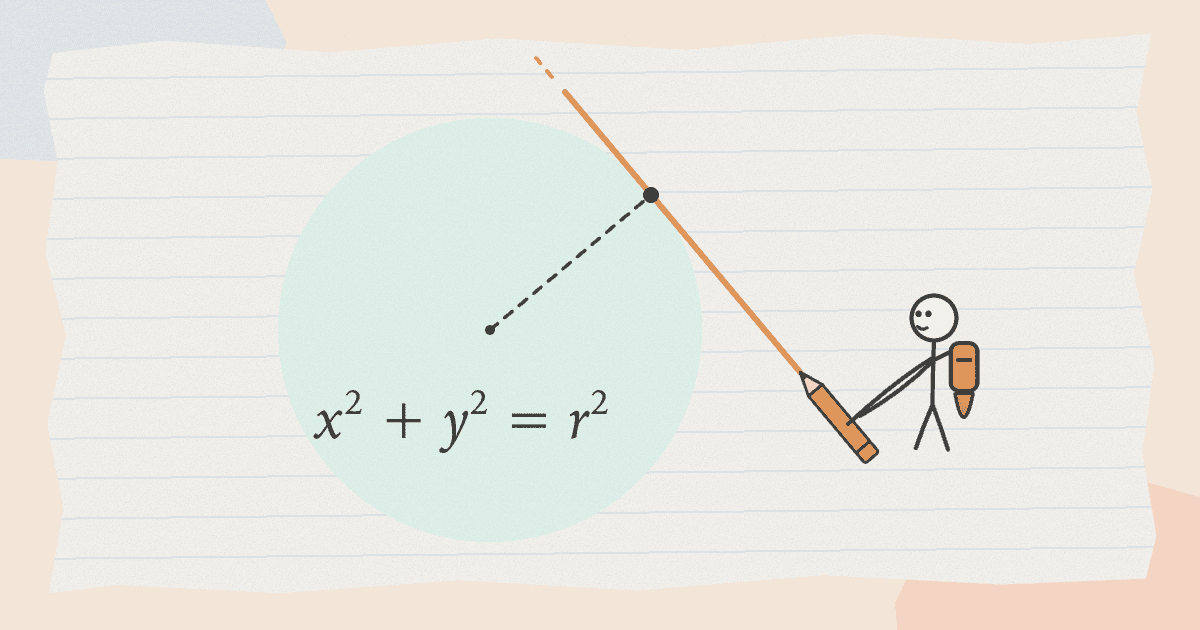
Implicit differentiation finds from an equation where is mixed in with , such as , without solving for first. Differentiate both sides with respect to , treating as a function of so that every term picks up a factor of , then solve for . For the circle, , so .
The formula
This is just the chain rule with as the inside function. The is the inside derivative, turning up for work like it always does.
When to use it
Use implicit differentiation when the equation does not come as and getting it into that form is painful or impossible: circles and ellipses, curves like , anything with or in it. It is also the engine behind related rates, where you differentiate with respect to time instead of . If you can solve for easily, you can, but implicit differentiation is often faster even then, and it gives you both halves of a circle at once.
How to do it, step by step
- Differentiate every term on both sides with respect to . Terms in alone are done as usual. Constants become 0.
- Attach to every term. Differentiate as if it were , then multiply by : becomes . A term like is a product, so it needs the product rule: .
- Collect the terms on one side. Everything with a goes left, everything else goes right.
- Factor out and divide. The answer will usually contain both and . That is normal. To get a number, substitute a point on the curve.
Worked examples
Example 1: A circle
EasyFind for the circle:
Differentiate both sides. The gives , the gives , and 25 gives 0.
Divide by . At the point the slope is , which is exactly perpendicular to the radius, as a circle's tangent should be.
Answer
Example 2: With an xy term
MediumFind for:
The middle term is a product of and , so it differentiates to .
Collect the terms and factor:
Divide by . At the point , which is on the curve because , the slope is .
Answer
Example 3: The folium of Descartes
HarderFind , and the slope of the tangent at :
Left side: . Right side: is a product, so .
Move the terms left and everything else right, then factor:
Divide through, and cancel the common 3. Then check is on the curve (, it is) and substitute:
Solving for would need the cubic formula. Nobody wants that, which is the whole case for doing it implicitly.
Answer
Your turn
Three to try, checked by the same machine that grades the game. Type the answer however you like; any correct form counts.
Problem 1
EasyFind for the ellipse:
Problem 2
MediumFind :
Problem 3
HarderFind :
Common mistakes
- Forgetting the . Writing is the number one slip. Every time you differentiate something with in it, a comes out.
- Treating as one thing. It is a product. , two terms, not alone and not .
- Not differentiating the right-hand side. A number on the right becomes 0, but an expression like needs differentiating too.
- Dividing before collecting. Get every term on one side and factor first. Dividing early leaves on both sides and a lot of crossing out.
Practice it now
Five minutes, no account
Implicit differentiation appears in a Sprint from difficulty 5 to 7: ellipses, an term, sums of cubes and full quadratics. Type in terms of and ; any algebraically equal form is marked right.
FAQ
- What is the difference between implicit and explicit differentiation?
- Explicit means is already on its own, , and you differentiate directly. Implicit means and are tangled together and you differentiate the whole equation, solving for afterwards.
- Why does dy/dx have y in it?
- Because one can sit under several points of the curve. On the circle , at there are two points, and , with opposite slopes. The in the answer tells them apart.
- How do you find the tangent line using implicit differentiation?
- Find , substitute the point to get the slope , then use . For the folium at the slope is , so the tangent is .
- How do you find horizontal and vertical tangents on an implicit curve?
- Horizontal tangents are where the top of is zero and vertical ones are where the bottom is zero, as long as the point is on the curve. For , is zero at , the points and , and undefined at and .
- How do you find the second derivative implicitly?
- Differentiate again with the quotient rule, again attaching to each , then substitute your first answer in for . For the circle this gives .
- Where can I find implicit differentiation practice problems?
- Right on this page: "Your turn" has three implicit differentiation practice problems, easy, medium and harder, checked as you type by the same checker that grades Asymptote, with the answer and the first step if you miss. For more practice against the clock, a five-minute Sprint is free and needs no account.
Keep going
Chain Rule: Steps, Examples & Practice Problems
How to use the chain rule on a function inside a function: the formula, four steps, three worked examples and three practice problems checked as you type.
Quotient Rule: Formula, Examples & Practice Problems
How to differentiate a fraction with the quotient rule: the formula, the low d-high rhyme, three worked examples and three practice problems to try.
Product Rule: Formula, Examples & Practice Problems
How to differentiate two functions multiplied together: the product rule formula, four steps, three worked examples and three practice problems to try.