Blog · Calculus guides · 19 October 2026 · 4 min read
Quotient Rule: Formula, Examples & Practice Problems
The quotient rule differentiates one function divided by another: . Take the derivative of the top times the bottom, subtract the top times the derivative of the bottom, and divide everything by the bottom squared. For example, .
The formula
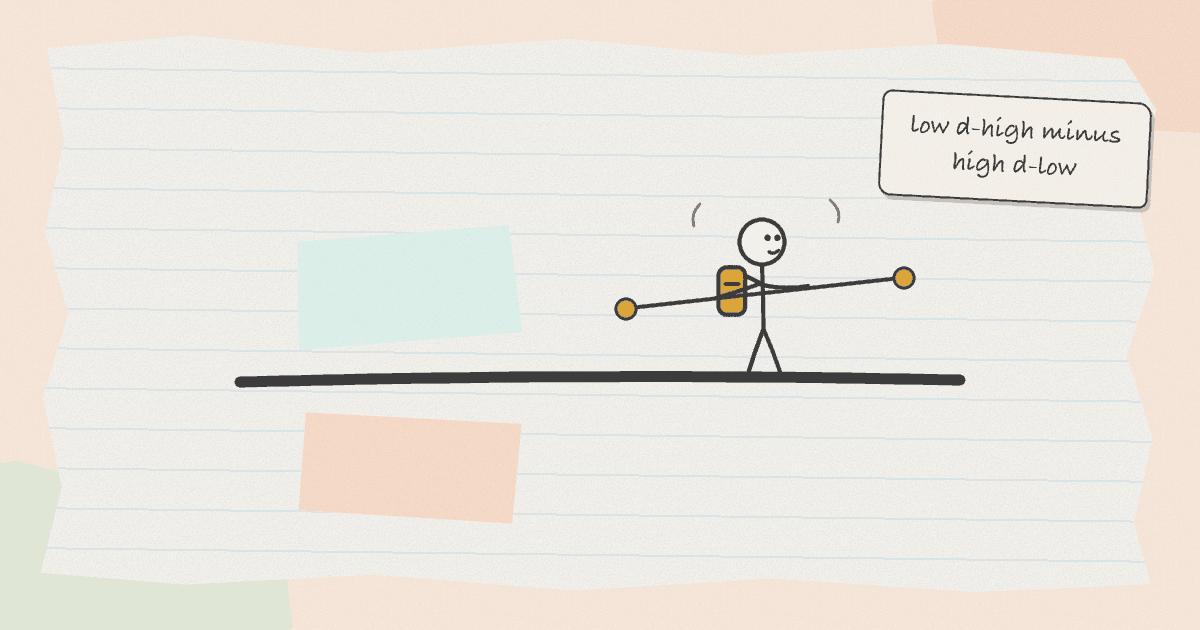
Say it as "low d-high minus high d-low, over the square of what's below". It is a terrible poem and it has saved more marks than any good one.
When to use it
Use the quotient rule when you have a fraction with in both the top and the bottom: , , . If only the top has in it, just divide: is . If the top is a constant, is quicker as and the power rule. And if you prefer, any quotient is a product in disguise, , so the product rule plus the chain rule always works too. It is just longer.
How to do it, step by step
- Label the top and the bottom . Write them on separate lines so you cannot mix them up.
- Differentiate both. Get and before you assemble anything.
- Build the numerator as . Top's derivative first. The order matters here, because of the minus sign: swap it and your answer comes out with the wrong sign.
- Divide by and simplify the top. Leave the bottom squared as it is; expanding only makes the answer harder to read.
Worked examples
Example 1: A polynomial over a linear bottom
EasyDifferentiate:
Top: , so . Bottom: , so .
Expand the numerator carefully. The minus sign applies to the whole of , both terms.
Collect like terms on top. You could pull out a 2 to get , but does not factor any further, so nothing cancels with the bottom and you are done.
Answer
Example 2: Trig over x
MediumDifferentiate:
Top: , . Bottom: , .
Nothing cancels, so tidy the order and stop. You will meet again in limits, where is probably the most famous result in the subject.
Answer
Example 3: An exponential over a quadratic
HarderDifferentiate, and simplify fully:
Top: , . Bottom: , .
Both terms on top contain , so factor it out, and what is left is a perfect square.
That square tells you something useful: the derivative is never negative, so this function never decreases. Simplifying is not just for neatness.
Answer
Your turn
Three to try, checked by the same machine that grades the game. Type the answer however you like; any correct form counts.
Problem 1
EasyDifferentiate:
Problem 2
MediumDifferentiate:
Problem 3
HarderDifferentiate, and simplify:
Common mistakes
- Getting the order of the top backwards. is exactly the negative of the right answer. Start with the derivative of the top, every time.
- Losing the minus across a bracket. In , the second bracket becomes , not . Bracket the whole of before you subtract.
- Forgetting to square the bottom. The denominator is , not .
- Cancelling across a minus sign. In you cannot cross out an , because only one of the two terms on top has one.
- Differentiating top and bottom separately. is what L'Hôpital's rule does for limits. It is not the derivative of a fraction.
Practice it now
Five minutes, no account
Quotient rule problems arrive in a Sprint at difficulty 4 and 5: a linear or quadratic top over a linear bottom. You do not have to expand anything; any correct form of the answer is accepted.
FAQ
- Why is the quotient rule harder than the product rule?
- It has a minus sign, so order matters, and a squared bottom to carry along. In our answer data, players get 76% of quotient-rule problems right against 84% for the product rule, and the lost marks are mostly sign errors in the numerator.
- Why is there a minus sign in the quotient rule?
- Because a bigger bottom makes a smaller fraction. If the top grows, goes up, so comes in with a plus. If the bottom grows, the fraction goes down, so comes in with a minus. Dividing by scales it to the right size.
- Is there a quotient rule for integrals?
- Not as such. For , first look for the top being the derivative of the bottom, which gives by substitution. For a polynomial over a polynomial, try partial fractions. Otherwise rewrite it as a product and see whether integration by parts helps.
- Can you use the product rule instead of the quotient rule?
- Yes. Write as and use the product rule with the chain rule. You will reach the same answer, often in a messier form that then needs a common denominator.
- How do you get the derivative of tan x from the quotient rule?
- Write . The rule gives , since .
- Where can I find quotient rule practice problems?
- Right on this page: "Your turn" has three quotient rule practice problems, easy, medium and harder, checked as you type by the same checker that grades Asymptote, with the answer and the first step if you miss. For more practice against the clock, a five-minute Sprint is free and needs no account.
Keep going
Product Rule: Formula, Examples & Practice Problems
How to differentiate two functions multiplied together: the product rule formula, four steps, three worked examples and three practice problems to try.
Chain Rule: Steps, Examples & Practice Problems
How to use the chain rule on a function inside a function: the formula, four steps, three worked examples and three practice problems checked as you type.
Implicit Differentiation: Steps, Examples & Practice Problems
How to find dy/dx when y is not on its own: implicit differentiation in four steps, three worked examples, tangent lines and three practice problems.