Blog · Calculus guides · 17 October 2026 · 4 min read
Integration by Parts: Formula, Examples & Practice Problems
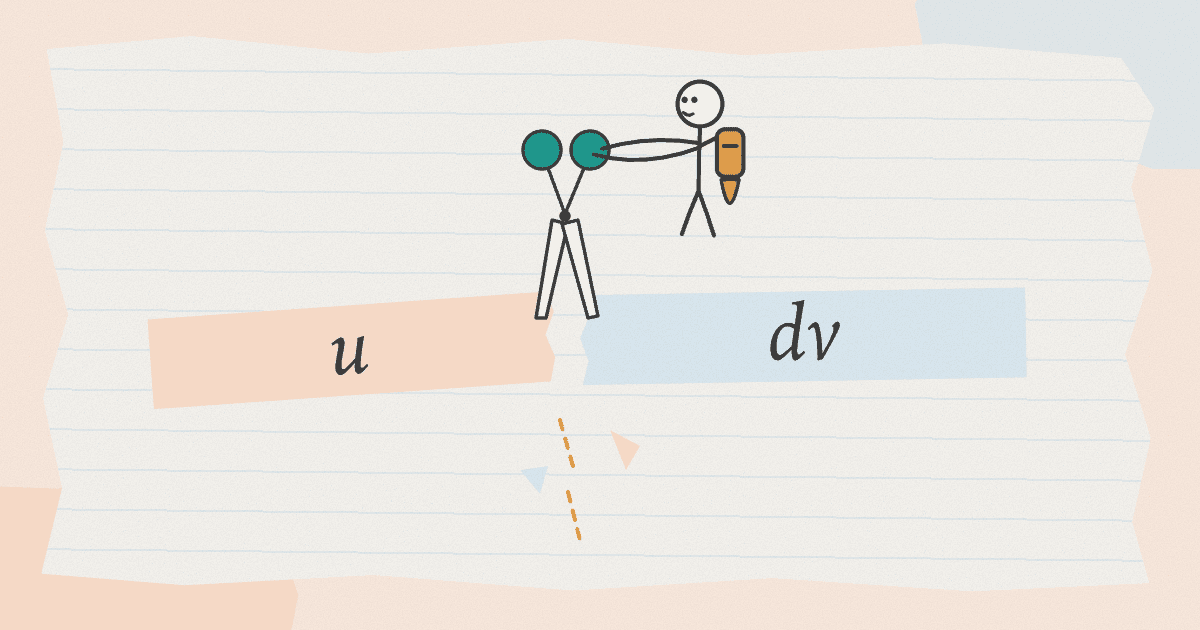
Integration by parts integrates a product of two functions using . You pick one factor to differentiate () and one to integrate (), so that the new integral is easier than the one you started with. For example, .
The formula
It is the product rule run backwards and rearranged. One integral goes in, a slightly different integral comes out, and the whole art is making sure the new one is nicer.
When to use it
Use integration by parts when the integrand is two different kinds of function multiplied together and there is no inside-and-its-derivative pattern for u-substitution to grab: , , . It also handles a few lone functions that have no obvious antiderivative, like and , by treating them as . If substitution works, use substitution: it is quicker. Parts is the tool for when the two factors have nothing to do with each other.
How to do it, step by step
- Choose and . Make the factor that gets simpler when you differentiate it. The LIATE order helps: Logs, Inverse trig, Algebraic (powers of ), Trig, Exponentials. Whichever comes first in that list is .
- Find and . Differentiate to get , integrate to get . Leave the off ; one constant at the very end is enough.
- Write out . Substitute all four pieces into the formula before you do anything clever.
- Do the new integral. If it is still a product, you may need parts again. If it looks worse than the original, go back and swap and .
- Add and check by differentiating. The product rule should hand you back the integrand exactly.
Worked examples
Example 1: A power times an exponential
EasyIntegrate:
By LIATE, (algebraic) beats (exponential), so and .
Into the formula:
The new integral is a plain exponential, which is exactly the point: differentiating made it vanish.
Answer
Example 2: When the log has to be u
MediumIntegrate:
Logs come first in LIATE, and for a good reason: you cannot integrate in your head, but you can differentiate it. So and .
The from cancels one power of , and what is left is the power rule in reverse.
Answer
Example 3: Parts twice
HarderIntegrate:
First round: , , so and .
The power of dropped from 2 to 1, so this is working. Second round, on : , , so and .
Put the two rounds together. Watch the signs: the minus in the formula meets the minus from , and that is where most wrong answers to this one come from.
Answer
Your turn
Three to try, checked by the same machine that grades the game. Type the answer however you like; any correct form counts.
Problem 1
EasyIntegrate:
Problem 2
MediumIntegrate:
Problem 3
HarderIntegrate:
Common mistakes
- Choosing backwards. With , setting and gives you , which is worse. If the new integral has grown, swap.
- Dropping the minus sign. The formula is minus , and when is itself negative (as it is for ) the signs stack. Write every line out; this is not the place for mental arithmetic.
- Forgetting the chain-rule factor in . The integral of is , not . Check by differentiating it before you use it.
- Stopping after one round. With in front you need two rounds, with three. Keep going until the power of is gone.
- Leaving out . One constant, at the end, on every indefinite integral.
Practice it now
Five minutes, no account
Integration by parts is the hardest thing in a Sprint: it only appears at difficulty 6 and 7, the top of Sprint's climb, as or times an exponential, a sine or cosine, or . The is optional when you type it: the game accepts any antiderivative.
FAQ
- How do you choose u in integration by parts?
- Use LIATE: Logs, Inverse trig, Algebraic, Trig, Exponentials. The first type in that list becomes . It is a rule of thumb rather than a law, but it is right for almost every textbook integral.
- Why is integration by parts so hard?
- Because it is the one rule where you have to make a choice before you can start, and a bad choice only shows itself two lines later. In our answer data it is the least-solved rule in the game: 63% right, with a median of 110 seconds for a correct answer. Slow is normal here.
- Is integration by parts the product rule backwards?
- Yes. The product rule says . Integrate both sides and you get ; move one integral across and that is the formula. So whenever you are unsure of an answer, differentiate it with the product rule and see whether the integrand comes back.
- How do you integrate ln x?
- Write it as with and . Then , and you get .
- Is there a faster way when I need parts several times?
- Yes: tabular integration puts the repeated rounds in a table, so takes one line instead of a page.
- Where can I find integration by parts practice problems?
- Right on this page: "Your turn" has three integration by parts practice problems, easy, medium and harder, checked as you type by the same checker that grades Asymptote, with the answer and the first step if you miss. For more practice against the clock, a five-minute Sprint is free and needs no account.
Keep going
Product Rule: Formula, Examples & Practice Problems
How to differentiate two functions multiplied together: the product rule formula, four steps, three worked examples and three practice problems to try.
Implicit Differentiation: Steps, Examples & Practice Problems
How to find dy/dx when y is not on its own: implicit differentiation in four steps, three worked examples, tangent lines and three practice problems.
Quotient Rule: Formula, Examples & Practice Problems
How to differentiate a fraction with the quotient rule: the formula, the low d-high rhyme, three worked examples and three practice problems to try.