Blog · Calculus guides · 26 October 2026 · 5 min read
Related Rates: Steps, Examples & Practice Problems
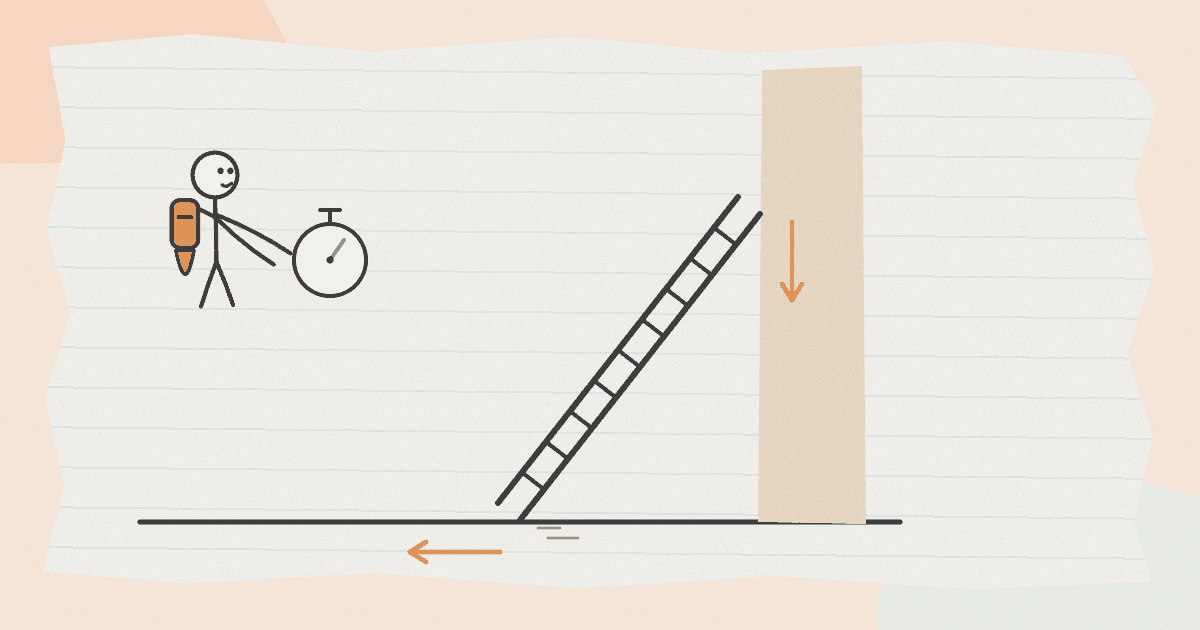
A related rates problem gives you how fast one quantity is changing and asks how fast another, linked one is changing at a particular moment. Write an equation connecting the quantities, differentiate both sides with respect to time , then substitute the values at that moment and solve for the unknown rate. For example, if a sphere's volume grows at , then at radius 5 cm its radius grows at cm/s.
The formula
Every quantity in the problem is secretly a function of time, so differentiating with respect to makes each one cough up its own rate. It is implicit differentiation with a stopwatch.
When to use it
Use this method on any word problem that talks about how fast something is changing "when" something else has a particular value: a ladder sliding down a wall, a balloon inflating, water filling a tank, a shadow lengthening, two cars driving apart. The tell is a rate you know (), a rate you want (), and a moment (). If the question asks for the biggest or smallest value of something instead, that is optimization, a close relative with a different method.
How to do it, step by step
- Draw it and name everything. Give a letter to every quantity that changes. Only write in numbers for things that never change, like the length of a ladder.
- Write down the rates. Turn the words into derivatives: "the base slides away at 2 ft/s" is . Write the one you want with a question mark.
- Find an equation linking the quantities. Pythagoras, a volume formula, similar triangles. If it has an extra variable, use the geometry to remove it now.
- Differentiate both sides with respect to . Every changing letter picks up its own , by the chain rule.
- Substitute the values at that moment, then solve. Only now do the "when" numbers go in. Finish with units and a sense check on the sign.
Worked examples
Example 1: Inflating a balloon
EasyAir is pumped into a spherical balloon at . How fast is the radius increasing when the radius is 5 cm?
Known: . Wanted: when . The link is the volume of a sphere.
Differentiate with respect to . The gives , times :
Now substitute and :
Note that is the balloon's surface area: the new air is spread over the whole skin, so a bigger balloon grows more slowly.
Answer
Example 2: The sliding ladder
MediumA 13 ft ladder leans against a wall. The base slides away from the wall at 2 ft/s. How fast is the top sliding down when the base is 5 ft from the wall?
Let be the distance from the wall to the base and the height of the top. The ladder stays 13 ft, so Pythagoras links them.
Differentiate with respect to , and cancel the 2s:
At this moment , so , and :
The minus sign means is shrinking: the top is sliding down at ft/s, which is what the question asked.
Answer
Example 3: Filling a cone
HarderWater flows at into an inverted cone with radius 3 m and height 6 m. How fast is the water level rising when the water is 4 m deep?
Let be the depth and the radius of the water's surface. The volume is , but that has two changing variables and we only know about .
Similar triangles remove : the water is a smaller cone with the same shape as the tank, so , that is . Do this before differentiating.
Substitute and :
The level rises more slowly as the cone widens, which is why a cocktail glass seems to take forever at the top and fill instantly at the bottom.
Answer
Your turn
Three to try, checked by the same machine that grades the game. Type the answer however you like; any correct form counts.
Problem 1
EasyAir is pumped into a spherical balloon at . How fast is the radius increasing, in cm/s, when the radius is 10 cm?
Problem 2
MediumA 10 ft ladder leans against a wall. The base slides away from the wall at 3 ft/s. How fast is the top moving, in ft/s, when the base is 6 ft from the wall? (Give a negative number.)
Problem 3
HarderA 6 ft tall person walks away from an 18 ft lamppost at 4 ft/s. How fast, in ft/s, is the tip of their shadow moving?
Common mistakes
- Substituting too early. If you put into the equation before differentiating, becomes a constant and its rate vanishes. Differentiate first, substitute second, always.
- Forgetting the factors. is , not . Every changing quantity carries its own rate.
- Getting the sign of a rate wrong. A quantity that is shrinking has a negative rate. Water draining out means .
- Keeping too many variables. In the cone, differentiating directly needs , which you do not know. Use the geometry to get down to one variable first.
Practice it now
No clock, three strikes
Related rates are Diverge-only, turning up around difficulty 7 and 8: a sliding ladder, a balloon, a filling cone and a lamppost shadow, much like the ones above. Give your answer as a decimal to three places, and keep the minus sign when something is shrinking.
FAQ
- What are related rates in calculus?
- Problems where two or more quantities are linked by an equation and all change with time. Knowing one rate of change lets you find another, by differentiating the equation with respect to time.
- How do you know which equation to use?
- It comes from the shape: Pythagoras for ladders and distances, the volume formula for balloons and tanks, similar triangles for shadows and cones. Draw the picture first; the equation is usually sitting in it.
- Why is my answer negative?
- Because that quantity is decreasing. In the ladder problem, means the top falls at ft/s. If a question asks how fast it is "sliding down", some books want , but the derivative itself is negative.
- How do you do the shadow problem?
- Similar triangles. For a 6 ft person walking away from a 15 ft lamp post, with the person's distance and the shadow's length, , so . The shadow's tip is at , so it moves times as fast as the person.
- Where can I find related rates practice problems?
- Right on this page: "Your turn" has three related rates practice problems, easy, medium and harder, checked as you type by the same checker that grades Asymptote, with the answer and the first step if you miss. For more practice against the clock, Diverge, which has no clock, is free and needs no account.
Keep going
Implicit Differentiation: Steps, Examples & Practice Problems
How to find dy/dx when y is not on its own: implicit differentiation in four steps, three worked examples, tangent lines and three practice problems.
Chain Rule: Steps, Examples & Practice Problems
How to use the chain rule on a function inside a function: the formula, four steps, three worked examples and three practice problems checked as you type.
Partial Fractions: Steps, Examples & Practice Problems
How to integrate a rational function with partial fractions: factor, split, solve, integrate. Three worked examples and three practice problems to try.