Blog · Calculus guides · 21 October 2026 · 4 min read
U-Substitution: Steps, Examples & Practice Problems
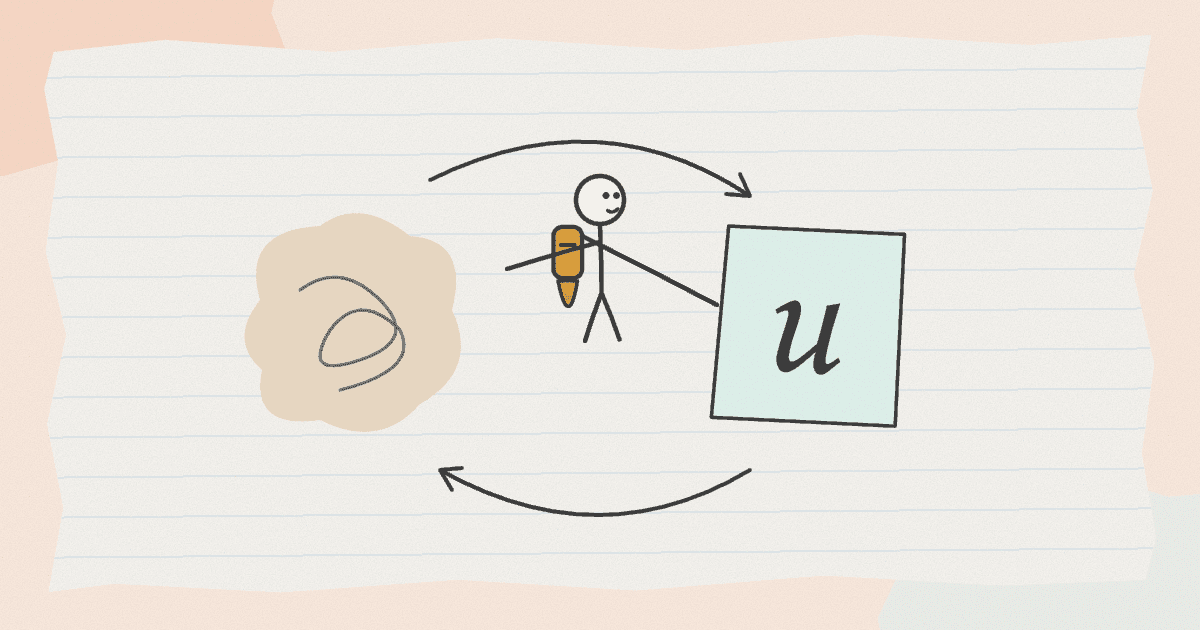
U-substitution integrates a function whose inside and the inside's derivative both appear in the integrand. Set equal to the inside, replace using , integrate the simpler expression in , then put back. For example, with , .
The formula
The chain rule, reversed. The chain rule multiplies by the inside derivative; substitution looks for that factor already sitting there and quietly removes it.
When to use it
Use substitution when you can see a function inside another function and the derivative of that inside is also in the integrand, up to a constant: has inside and (half its derivative) outside; has and its derivative . It is always worth trying before integration by parts, because when it works it is much shorter. If the inside's derivative is nowhere to be found, substitution usually turns the problem into a mess, and that is your sign to try something else.
How to do it, step by step
- Choose . Pick the inside of the most awkward-looking piece: the bracket under a power, the argument of or , the thing under a root, the denominator.
- Find . Differentiate: . Rearrange so you can swap out whatever is in the integrand, for example .
- Rewrite the whole integral in . No may survive, and no . If an is left over, solve for and substitute that in too.
- Integrate, then substitute back. Replace with and add .
Worked examples
Example 1: A bracket and its derivative
EasyIntegrate:
The inside is and its derivative, , is sitting right there. Let , so .
Put back in place of . Expanding and integrating term by term would also work, eventually, after a lot of binomial coefficients. Substitution does it in one line.
Answer
Example 2: A logarithm in the denominator
MediumIntegrate, for :
This one does not look like it has an inside at all, until you split it as . Then is the inside and is its derivative.
Let , so :
Substitute back. The absolute value matters: is negative for .
Answer
Example 3: When an x is left over
HarderIntegrate:
Let , so . That deals with the root, but leaves a stray outside it. Solve for it: .
Now it is two powers, which the power rule handles in reverse: add one to the power, divide by the new power.
Swap back for . This trick, substituting for the leftover , is what turns a lot of "substitution doesn't work here" integrals into ones where it does.
Answer
Your turn
Three to try, checked by the same machine that grades the game. Type the answer however you like; any correct form counts.
Problem 1
EasyIntegrate:
Problem 2
MediumIntegrate:
Problem 3
HarderIntegrate, for :
Common mistakes
- Leaving in the integral. is not . Swap for properly, constant factor included.
- Losing the constant. In , means , so the answer is . Forgetting the doubles the answer.
- Mixing and . If the integral still has an after substituting, either solve for in terms of or try a different .
- Not substituting back. The question was in , so the answer must be too.
- Forgetting to change the limits. On a definite integral, either change the limits to -values or substitute back before plugging in. Never mix the two.
Practice it now
Five minutes, no account
Substitution integrals come up in a Sprint from difficulty 5 to 7: times a power, sine, cosine or exponential of a quadratic, and . The is optional; the game accepts any antiderivative.
FAQ
- How do you know what to pick for u?
- Look for the inside of a composition whose derivative also appears. Good first guesses: the bracket under a power, the argument of or a trig function, the expression under a square root, or a denominator.
- What if du is not exactly what is in the integral?
- If it is off by a constant, that is fine: divide it out. For , , so and the answer is . If it is off by a power of , it is not fine. has no to pair with , and in fact it has no elementary antiderivative at all, so no choice of will rescue it.
- Is u-substitution the reverse of the chain rule?
- Yes. Differentiate with the chain rule and you get back . That is also the quickest way to check any substitution answer.
- When should you use u-substitution instead of integration by parts?
- When one part of the integrand is the derivative of another part's inside. If the two factors are unrelated, like and , substitution cannot help and parts is the tool.
- Can you use u-substitution on definite integrals?
- Yes. Change the limits as well: if and runs from 0 to 1, then runs from 1 to 2. Then you never have to substitute back.
- Where can I find u-substitution practice problems?
- Right on this page: "Your turn" has three u-substitution practice problems, easy, medium and harder, checked as you type by the same checker that grades Asymptote, with the answer and the first step if you miss. For more practice against the clock, a five-minute Sprint is free and needs no account.
Keep going
Chain Rule: Steps, Examples & Practice Problems
How to use the chain rule on a function inside a function: the formula, four steps, three worked examples and three practice problems checked as you type.
Integration by Parts: Formula, Examples & Practice Problems
How to integrate a product by parts: the formula, choosing u with LIATE, three worked examples and three practice problems checked as you type.
Implicit Differentiation: Steps, Examples & Practice Problems
How to find dy/dx when y is not on its own: implicit differentiation in four steps, three worked examples, tangent lines and three practice problems.