Blog · Calculus guides · 31 October 2026 · 4 min read
By the Asymptote team. Every answer on this page is checked by the same machine that grades the game.
Squeeze Theorem: 3 Examples & Practice Problems
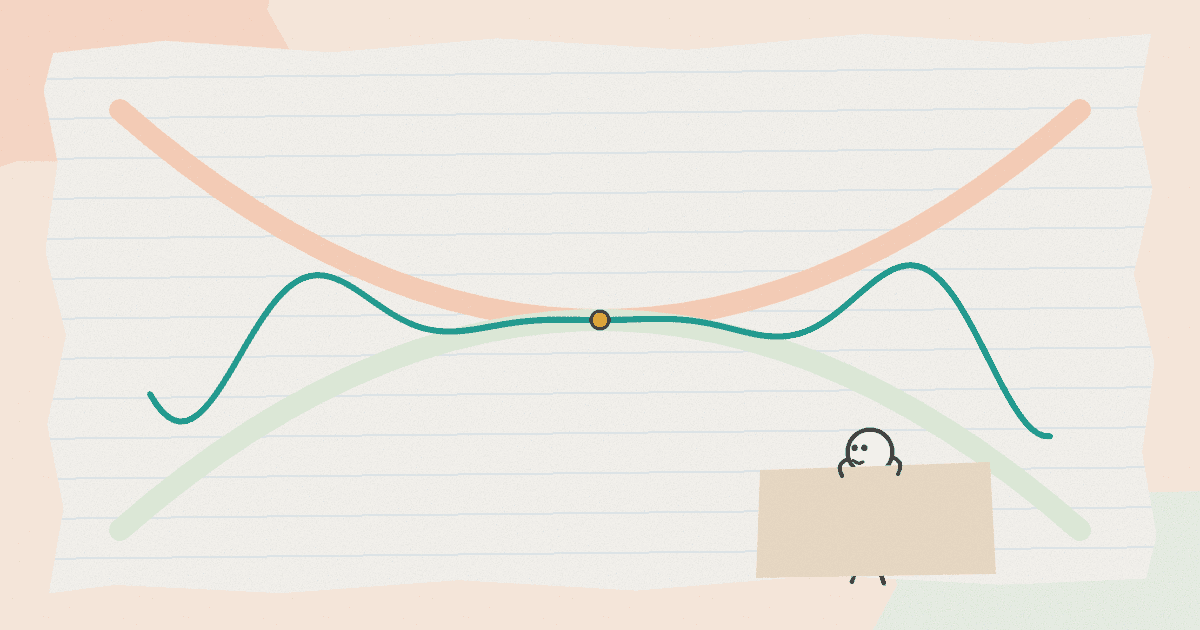
The squeeze theorem says that if near , and and both tend to the same limit as , then tends to too. It is how you find limits of functions that wobble, like as , where substitution fails and nothing cancels. Trap the function between two simpler ones that agree, and it has nowhere else to go.
The formula
Also sold as the sandwich theorem, and in Italy as the two carabinieri theorem: two police officers walking a suspect to the station, one on each side.
When to use it
Use the squeeze theorem when a limit involves something bounded but badly behaved, usually or of something that blows up, multiplied by something that goes to zero. The bounded part is the giveaway: always, so you can bound the whole expression without knowing what the inside does. If plain substitution, factoring or L'Hôpital's rule works, use that instead; the squeeze is for the limits those methods cannot touch.
How to do it, step by step
- Find the bounded piece. Usually or , which sits between and whatever is inside it.
- Write the inequality for that piece. For example .
- Build the rest of around it. Multiply or divide every part of the inequality by the other factor. If that factor is negative, flip the inequality signs; if it is positive (like ), they stay put.
- Take the limit of both bounds. If they agree on , write the conclusion: by the squeeze theorem, . If they disagree, your bounds are too loose, and you need tighter ones.
Worked examples
Example 1: A wobble times something small
EasyFind the limit:
Substitution gives , which is meaningless, and itself has no limit at : it oscillates faster and faster between and .
But it is bounded. Start there and multiply through by , which is positive, so the inequalities keep their direction:
Both and go to as . The function is pinned between them, so it goes to as well, however much it wiggles on the way.
On a graph, is a wave trapped inside the two parabolas and , wiggling infinitely often as it is crushed into the origin.
Answer
Example 2: A limit at infinity
MediumFind the limit:
L'Hôpital's rule does not apply: the top does not go to or , it just keeps oscillating. The bound does the work instead.
For , divide through by :
Both bounds go to as , so the function does too. On a graph, that is a wave whose height shrinks like , settling onto the horizontal asymptote while crossing it infinitely often.
Answer
Example 3: The famous one
HarderShow that:
Substitution gives , and L'Hôpital's rule would need the derivative of , which is itself proved using this limit. So it has to come from geometry.
Take on the unit circle. A small triangle, a sector of angle and a larger triangle sit inside each other, with areas , and :
The middle step divides by ; the last one flips everything upside down, which reverses the inequalities. Both bounds tend to as . For negative , takes the same values, since both top and bottom change sign, so the limit from the left is as well.
Answer
Squeeze theorem practice problems
Three to try, easy to harder. Type an answer and it is checked instantly by the same checker that grades the game; any correct form counts. Stuck? The answer and the first step are under each one.
Problem 1
EasyFind the limit:
Stuck? Show the answer
Answer
How to start
Start from and multiply by : the function is trapped between and .
Problem 2
MediumFind the limit:
Stuck? Show the answer
Answer
How to start
Since , the top is between and . Divide those bounds by and take their limits.
Problem 3
HarderFind the limit:
Stuck? Show the answer
Answer
How to start
Multiply top and bottom by , so the top becomes . Then build , the squeezed limit, which tends to .
Want more? Asymptote has 243 related problems, free, with no account.
Common mistakes
- Bounds that do not agree. is true, but the bounds tend to and , so it proves nothing about alone. The squeeze only works when both sides meet.
- Forgetting to flip the inequality. Multiplying by a negative number reverses both signs. If is in play, check which bound is really on top.
- Writing along the way. It has no limit at all. The product has a limit because the crushes it, not because the sine settles down.
- Splitting the limit of a product. is not allowed when the second limit does not exist. That is precisely the case the squeeze theorem exists for.
Practice it now
Five minutes, no account
Asymptote has no squeeze-theorem problems as such, since a proof is hard to type into a box. The closest thing is the standard trig limits, and friends as , which run on the limit in the third example and turn up in a Sprint once the difficulty reaches 4.
FAQ
- Is the squeeze theorem the same as the sandwich theorem?
- Yes, same theorem, different snack. It is also called the pinching theorem.
- When do you use the squeeze theorem?
- When the function has a bounded factor that oscillates, such as or of something that blows up, multiplied by a factor that tends to zero.
- Does the squeeze theorem work for limits at infinity?
- Yes. The inequality only has to hold for large enough , and both bounds must tend to the same limit as .
- Why is important?
- It is the limit behind , and every trig derivative is built from that one.
- Where can I find squeeze theorem practice problems?
- Right on this page: the practice problems section has three squeeze theorem problems, easy, medium and harder, with the answer and the first step under each one, and a box that checks what you type with the same checker that grades Asymptote. The game has 243 related problems after that, free and with no account: try a five-minute Sprint.
Keep going
L'Hôpital's Rule: When to Use It & Practice Problems
L'Hôpital's rule: for 0/0 or ∞/∞, the limit of f/g equals the limit of f'/g'. When it applies, 3 worked examples and practice problems with answers.
Derivatives of Trig Functions: Table & Practice Problems
Derivatives of sin, cos, tan, cot, sec and csc in one table: (sin x)' = cos x, (cos x)' = −sin x. A trick for the signs, 3 examples and practice problems.
Trig Substitution: Which to Use & Practice Problems
Trig substitution: a²−x² → x = a sin θ, a²+x² → x = a tan θ, x²−a² → x = a sec θ. Converting back with a triangle, 3 examples and practice problems.