Blog · Calculus guides · 8 November 2026 · 4 min read
By the Asymptote team. Every answer on this page is checked by the same machine that grades the game.
Area Under a Curve: Definite Integrals & Practice Problems
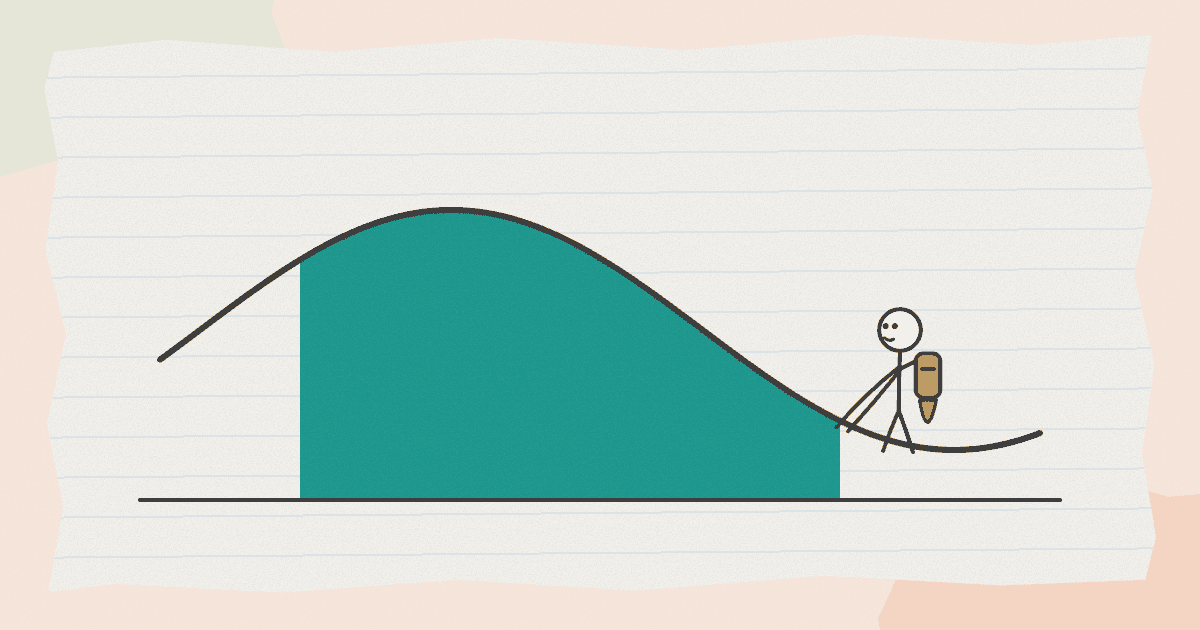
The area under a curve from to is the definite integral , as long as the curve stays above the -axis. Find an antiderivative , then compute . If the curve dips below the axis, split the interval where it crosses and add up the sizes of the pieces.
The formula
Infinitely many infinitely thin rectangles, added up, and then the Fundamental Theorem lets you skip every single one of them.
When to use it
Use it whenever a question asks for the area between a graph and the -axis, or for a total built up from a rate: distance from a velocity, water from a flow rate, money from a rate of income. A definite integral is area with a sign attached. Parts above the axis count as positive, and parts below count as negative. So when a question says "area", first check whether the curve goes below the axis between and . If it does not, the integral is the area. If it does, the integral is not the area, and the difference can be large.
How to do it, step by step
- Find where the curve crosses the axis. Solve and keep the roots between and . They split the interval into pieces where has one sign.
- Find an antiderivative. Reverse the derivative rules: , , and so on. No is needed for a definite integral, because it cancels.
- Evaluate on each piece. Top limit first, then subtract the bottom one. Brackets around save a lot of sign errors.
- Add the sizes of the pieces. Take the absolute value of any piece that came out negative, then add. With no crossings there is only one piece and you are done.
Worked examples
Example 1: A parabola above the axis
EasyFind the area under from to .
is never negative, so the integral is the area. An antiderivative of is .
A quick sanity check: the curve reaches 12 at , so the whole region fits inside a 2 by 12 rectangle of area 24. An answer of 8, a third of that, is believable. An answer of 30 would not be.
Answer
Example 2: One arch of sine
MediumFind the area under one arch of , from to .
Sine is positive between and , so again the integral is the area. The antiderivative of is , and that minus sign is the thing to watch.
A curved shape with an area of exactly 2, which feels like it should not be allowed.
Answer
Example 3: A curve that dips below the axis
HarderFind the total area between and the -axis from to .
First the crossings: at , and is inside . The curve is below the axis on and above it on , so
Use for both, flipping the sign on the first piece:
Add them: . For comparison, the plain integral is , because the part below the axis cancels some of the part above. Same curve, same limits, answers three times apart.
Answer
Area under a curve practice problems
Three to try, easy to harder. Type an answer and it is checked instantly by the same checker that grades the game; any correct form counts. Stuck? The answer and the first step are under each one.
Problem 1
EasyFind the area under from to :
Stuck? Show the answer
Answer
How to start
is never negative on , so the integral is the area. An antiderivative of is .
Problem 2
MediumFind the area under from to :
Stuck? Show the answer
Answer
How to start
is always positive. Its antiderivative is : the undoes the 2 the chain rule would bring down.
Problem 3
HarderFind the total area between and the -axis from to :
Stuck? Show the answer
Answer
How to start
Sine is above the axis on and below it on . Integrate each piece separately and add their sizes; the plain integral would give 0.
Want more? Asymptote has 608 more area under a curve problems, free, with no account.
Common mistakes
- Integrating straight through a crossing. If the curve goes below the axis, is the net signed area, not the area. Find the roots first.
- Subtracting the wrong way round. It is , top limit minus bottom. Backwards gives the right number with the wrong sign, which is the most annoying kind of wrong.
- Dropping a minus sign from . often has several terms. Put it in brackets before you subtract it.
- Swapping the sine and cosine antiderivatives. and . When in doubt, differentiate your answer and see if you get back where you started.
Practice it now
Five minutes, no account
Sprint has definite integrals from its early problems: a single power from first, then polynomials, sines, cosines and exponentials between small limits. They are signed integrals, so a negative answer can be right; there are no absolute-value area problems as such.
FAQ
- Is the area under a curve the same as the integral?
- Only when the curve stays on or above the -axis. Otherwise the integral counts the parts below as negative, and the area is the integral of .
- Can the area under a curve be negative?
- Area cannot. A definite integral can, when more of the curve sits below the axis than above it.
- How do you find the area between two curves?
- Integrate the top curve minus the bottom curve between the points where they cross. See area between curves.
- Do you need in a definite integral?
- No. Any constant would appear in both and , and cancel when you subtract.
- How do you find the area under a curve without integration?
- Approximate it with rectangles: a Riemann sum with left, right or midpoint heights. More rectangles give a better estimate, and the limit of those sums as the rectangles get thinner is exactly the definite integral.
- Where can I find area under a curve practice problems?
- Right on this page: the practice problems section has three area under a curve problems, easy, medium and harder, with the answer and the first step under each one, and a box that checks what you type with the same checker that grades Asymptote. The game has 608 more area under a curve problems after that, free and with no account: try a five-minute Sprint.
Keep going
Fundamental Theorem of Calculus: Examples & Practice Problems
The Fundamental Theorem of Calculus: ∫f from a to b = F(b) − F(a), and d/dx of an integral is the integrand. 3 worked examples and practice problems.
Riemann Sums: Left, Right, Midpoint & Practice Problems
A Riemann sum adds f(x)·Δx over n strips. Left, right and midpoint step by step, over or underestimate, 3 worked examples and practice problems.
Area Between Curves: Formula, 3 Examples & Practice Problems
The area between two curves is ∫(top − bottom) dx between where they meet. Curves that cross, 3 step-by-step examples and practice problems with answers.