Blog · Calculus guides · 3 November 2026 · 4 min read
By the Asymptote team. Every answer on this page is checked by the same machine that grades the game.
Area Between Curves: Formula, 3 Examples & Practice Problems
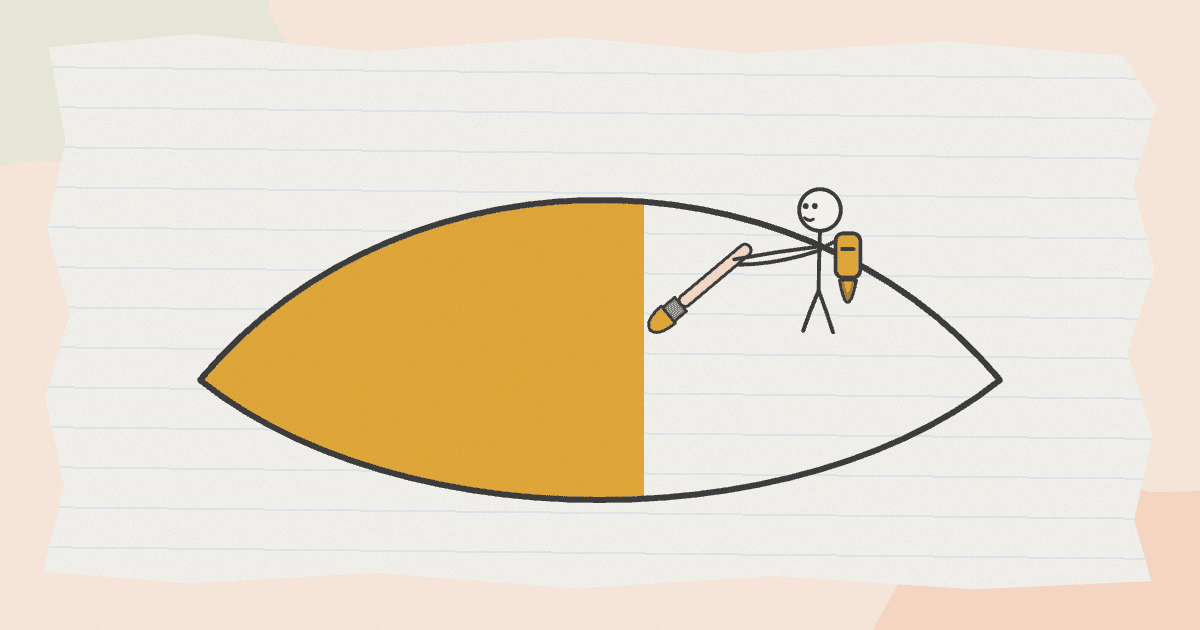
The area between two curves is the integral of the top curve minus the bottom curve: , where on . The limits are usually where the curves meet, found by setting . If the curves cross in between, split the integral at each crossing so every piece is top minus bottom.
The formula
The area under the top curve, minus the area under the bottom one. Nothing more mysterious than cutting a shape out of a bigger shape.
When to use it
Use this whenever a question asks for the area enclosed by two or more curves, or between a curve and a line. It is the area under a curve with a second curve taking the place of the -axis, and it is also the first step of every volume problem: disks and washers and shells start from exactly this region. If the curves are easier to write as in terms of , integrate right minus left in instead.
How to do it, step by step
- Find where the curves meet. Set them equal and solve. Those -values are usually your limits.
- Decide which curve is on top. Pick any test point between the limits and compare the two values. Do not trust the way the equations look.
- Check for crossings. If the curves meet again between your limits, the top and bottom swap there, and you need a separate integral for each piece.
- Integrate top minus bottom and add the pieces. Every piece should come out positive. If one is negative, its top and bottom are the wrong way round.
Worked examples
Example 1: A line and a parabola
EasyFind the area enclosed by and .
Set them equal: , so , giving and .
Test : the line gives , the parabola gives . The line is on top.
Read it as the triangle under the line, which has area , minus the part under the parabola, . That is the formula doing exactly what the caption promised.
Answer
Example 2: Limits that need a quadratic
MediumFind the area enclosed by and .
Set them equal: , so , which factors as . The curves meet at and .
Test : the parabola gives , the line gives . The parabola is on top, so the integrand is .
The bracket for is negative, so subtracting it adds. Brackets around the lower limit save marks here.
Answer
Example 3: Curves that cross
HarderFind the total area enclosed by and .
Set them equal: , so . They meet three times, at , and , which makes two separate regions.
Test each one. At , the line gives and the cubic , so the line is on top on . At it is the other way round: the cubic is on top on .
Both curves are odd functions, so the left region is the right one rotated half a turn about the origin, and has the same area. Add the two pieces.
If you had integrated straight from to , the two pieces would cancel and you would get : a region with no area, which should make anyone suspicious.
Answer
Area between curves practice problems
Three to try, easy to harder. Type an answer and it is checked instantly by the same checker that grades the game; any correct form counts. Stuck? The answer and the first step are under each one.
Problem 1
EasyFind the area enclosed by the two curves:
Stuck? Show the answer
Answer
How to start
They meet where , at and . The line is on top, so integrate from to .
Problem 2
MediumFind the area enclosed by the two parabolas:
Stuck? Show the answer
Answer
How to start
They meet at . Top minus bottom is .
Problem 3
HarderFind the total area enclosed by the curve and the -axis:
Stuck? Show the answer
Answer
How to start
The curve crosses the axis at , so there are two regions, one above the axis and one below. Work out and use the symmetry.
Want more? Asymptote has 380 more area between curves problems, free, with no account.
Common mistakes
- Bottom minus top. You get the right size with the wrong sign. An area cannot be negative, so a negative answer is a free warning.
- Integrating across a crossing. If the curves swap over between your limits, one integral counts part of the area as negative and cancels it out. Split at every crossing.
- Guessing the limits. The limits come from solving top = bottom, not from the question's diagram. Solve the equation, even when the picture looks obvious.
- Losing a sign at the lower limit. with a negative is where most arithmetic slips happen. Bracket before you subtract it.
Practice it now
No clock, three strikes
Area problems arrive in Diverge around d6-d7: a line and a parabola, two parabolas, a parabola cut by a line, and a cubic against the -axis that needs the split from the third example. Answers are exact numbers, so roots like stay as roots.
FAQ
- How do you know which curve is on top?
- Pick a number between the limits, plug it into both, and see which is bigger. One test point per region is enough, as long as the curves do not cross inside it.
- Can the area between curves be negative?
- No. A negative result means top and bottom are swapped somewhere. A definite integral can be negative; an area cannot.
- When should I integrate with respect to ?
- When the region is bounded on the left and right by curves of the form , such as . Then the area is the integral of right minus left, .
- What if the curves cross more than once?
- Find every crossing, split the interval at each one, and integrate top minus bottom on each piece, then add.
- Where can I find area between curves practice problems?
- Right on this page: the practice problems section has three area between curves problems, easy, medium and harder, with the answer and the first step under each one, and a box that checks what you type with the same checker that grades Asymptote. The game has 380 more area between curves problems after that, free and with no account: try Diverge, which has no clock.
Keep going
Area Under a Curve: Definite Integrals & Practice Problems
The area under a curve is the definite integral ∫f(x) dx from a to b, split where f dips below the x-axis. 4 steps, worked examples and practice problems.
Disk and Washer Method: Formulas & Practice Problems
Disk method: V = π∫R² dx. Washer method: V = π∫(R² − r²) dx. Choosing the outer and inner radius, 3 worked examples and practice problems with answers.
Shell Method: Formula, 3 Examples & Practice Problems
The shell method: V = 2π∫(radius)(height) dx. How to read off the radius and height, when to choose shells, 3 worked examples and practice problems.