Blog · Calculus guides · 1 November 2026 · 4 min read
By the Asymptote team. Every answer on this page is checked by the same machine that grades the game.
Shell Method: Formula, 3 Examples & Practice Problems
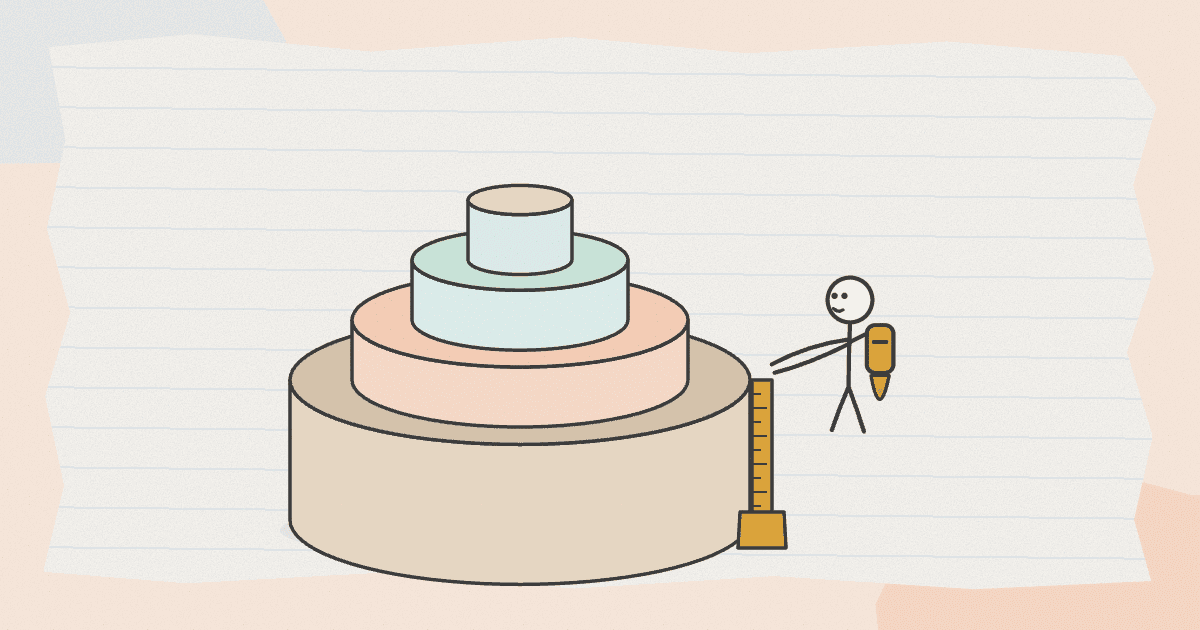
The shell method finds the volume of a solid of revolution by slicing it into thin cylindrical shells, like the layers of an onion. Each shell has volume , so . It is usually the easier choice when you spin a region of the form around a vertical axis.
The formula
Unroll a shell and it is a flat sheet: long, tall, thick. That is the whole derivation, and it fits on a paper towel tube.
When to use it
Use shells when the axis of rotation is parallel to the strips you would naturally draw. For a region under spun around the -axis (or any vertical line), shells let you integrate in with no need to solve for in terms of . If the same region spins around the -axis, disks and washers are usually more direct. Both methods give the same volume; the right one is just the one with the easier integral.
How to do it, step by step
- Sketch the region and the axis. Draw one thin vertical strip at a typical . Spinning that strip around the axis makes one shell.
- Find the radius. It is the distance from the strip to the axis. About the -axis that is ; about the line it is , written so it comes out positive.
- Find the height. The top curve minus the bottom curve at that . Down to the -axis it is just .
- Set the limits. The -values where the region starts and stops, from the sketch or from where the curves meet.
- Integrate . Expand the product first: it is almost always a polynomial by then.
Worked examples
Example 1: A parabola around the y-axis
EasyThe region under from to is revolved about the -axis. Find the volume.
A vertical strip at has radius (its distance from the -axis) and height (from the -axis up to the curve).
With disks you would need and a washer with a hole in it: outer radius , inner radius , for from to . That gives as well, which is reassuring, but shells got there without rewriting anything.
Answer
Example 2: Between two curves
MediumThe region between and is revolved about the -axis. Find the volume.
The curves meet where , at and . In between, is on top (try : ).
So a strip at has radius and height , top minus bottom.
Answer
Example 3: Around a shifted axis
HarderThe region under and above the -axis is revolved about the line . Find the volume.
The parabola crosses the -axis at and , so the region runs from to . Every strip in it is to the left of the axis .
The radius is the distance from to , which is (positive for every in the region). The height is .
Using for the radius here would be measuring from the wrong line entirely, and would give , half the right answer.
Answer
Shell method practice problems
Three to try, easy to harder. Type an answer and it is checked instantly by the same checker that grades the game; any correct form counts. Stuck? The answer and the first step are under each one.
Problem 1
EasyThe region under the curve from to is revolved about the -axis. Use shells to find the volume.
Stuck? Show the answer
Answer
How to start
Radius , height , so . The lower limit is , not .
Problem 2
MediumThe region under the curve from to is revolved about the -axis. Find the volume.
Stuck? Show the answer
Answer
How to start
Radius times height is , so you need . Remember .
Problem 3
HarderThe region under the curve and above the -axis is revolved about the line . Find the volume.
Stuck? Show the answer
Answer
How to start
The region runs from to . Its distance from the axis is , so the integrand is : expand it before integrating.
Want more? Asymptote has 400 more shell method problems, free, with no account.
Common mistakes
- Using as the radius for every axis. It is only about the -axis. About it is the distance , so for an axis to the right of the region and for the axis .
- Dropping the . The circumference is , and the belongs outside the integral. Without it the answer is a cross-section, not a volume.
- Getting the height upside down. Height is top curve minus bottom curve. A negative height means they are the wrong way round.
- Mixing variables. Vertical strips mean everything is in , including the limits. Do not put -values in as limits of a integral.
Practice it now
No clock, three strikes
Shell problems appear in Diverge at around d8-d9: the region under between two -values, spun about the -axis. Shifted axes and regions between two curves are not in the game yet. Answers are exact, in terms of .
FAQ
- When do you use the shell method instead of the disk method?
- When the axis of rotation is parallel to your strips: vertical strips and a vertical axis, for example. Shells then let you integrate in the variable the curve is already written in.
- Do the shell and washer methods give the same answer?
- Yes, always, if both are set up correctly. It is a good way to check one with the other when the integrals are both manageable.
- What is the radius in the shell method?
- The distance from the strip to the axis of rotation. About the -axis it is ; about it is .
- Can you use shells around the -axis?
- Yes, with horizontal strips: , where is the width of the region at height . It means writing as a function of .
- Where can I find shell method practice problems?
- Right on this page: the practice problems section has three shell method problems, easy, medium and harder, with the answer and the first step under each one, and a box that checks what you type with the same checker that grades Asymptote. The game has 400 more shell method problems after that, free and with no account: try Diverge, which has no clock.
Keep going
Fundamental Theorem of Calculus: Examples & Practice Problems
The Fundamental Theorem of Calculus: ∫f from a to b = F(b) − F(a), and d/dx of an integral is the integrand. 3 worked examples and practice problems.
Related Rates: 5 Steps, Ladder & Cone, Practice Problems
Related rates in 5 steps: name it, link it, differentiate with respect to t, then plug in. Balloon, ladder and cone examples and practice problems.
Squeeze Theorem: 3 Examples & Practice Problems
The squeeze theorem: if g ≤ f ≤ h and g, h share a limit L, so does f. How to find the bounds for x² sin(1/x) and friends, 3 examples, practice problems.