Blog · Calculus guides · 2 November 2026 · 4 min read
By the Asymptote team. Every answer on this page is checked by the same machine that grades the game.
Disk and Washer Method: Formulas & Practice Problems
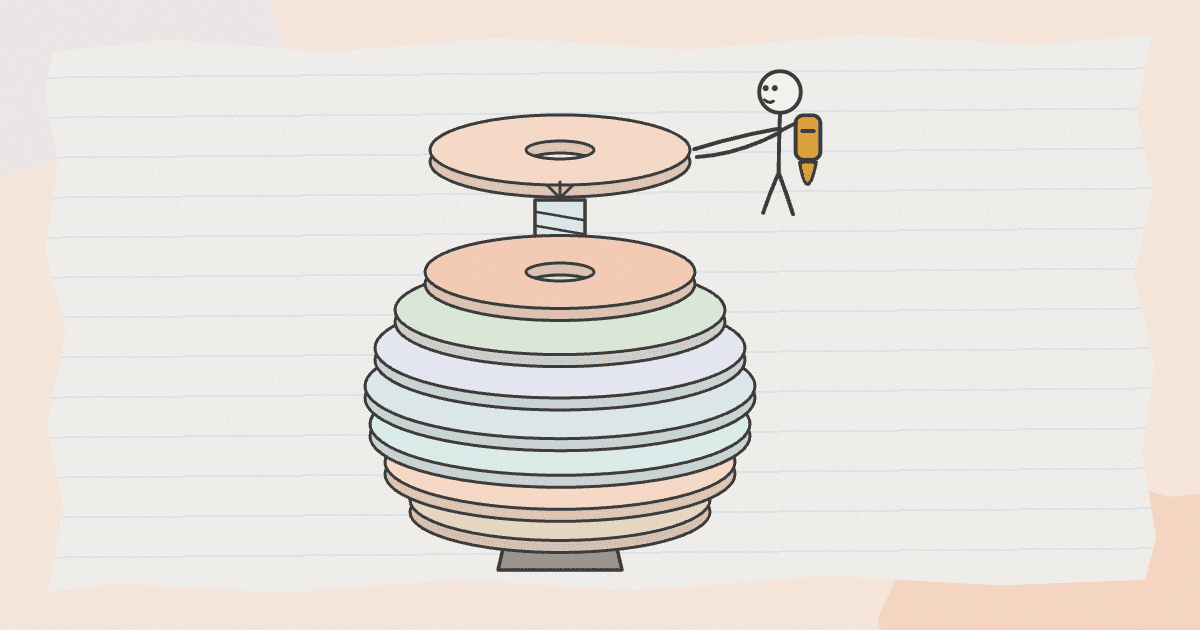
The disk method slices a solid of revolution into thin circular disks, each of volume , so . When the solid has a hole through the middle, each slice is a washer instead, and you subtract the hole: , where is the outer radius and the inner one.
The formula
A washer is a disk that has had its middle eaten. Square each radius first, then subtract: the order is the entire trick.
When to use it
Use disks or washers when the axis of rotation is perpendicular to your strips: vertical strips spun around the -axis or any horizontal line. If the region touches the axis all the way along, every slice is a solid disk. If there is a gap between the region and the axis, the slices have holes and you need washers. When the axis is parallel to the strips instead, the shell method is usually less work.
How to do it, step by step
- Sketch the region and the axis. Draw one thin strip perpendicular to the axis. Spinning it makes one disk or one washer.
- Find the outer radius . The distance from the axis to the far edge of the region. About the -axis that is the curve farther from it.
- Find the inner radius . The distance from the axis to the near edge. If the region touches the axis, and you have a disk.
- Square, subtract, integrate. between the limits of the region. Expand before integrating.
Worked examples
Example 1: A square root around the x-axis
EasyThe region under from to is revolved about the -axis. Find the volume.
The region touches the -axis everywhere, so each slice is a solid disk of radius .
Squaring the radius got rid of the root before any integrating happened, which is the disk method being generous for once.
Answer
Example 2: A washer between two curves
MediumThe region between and is revolved about the -axis. Find the volume.
The curves meet at and , and is above in between. The region does not touch the axis (except at the ends), so the slices are washers.
The outer radius is the curve farther from the axis, . The inner radius is the nearer one, .
Picture it as a cone with a narrower, curved cone scooped out of it: the line alone would sweep out a cone of volume , and the hole made by takes of that away.
Answer
Example 3: Around the line y = 2
HarderThe same region, between and , is revolved about the line . Find the volume.
Now the axis is above the region, so the radii are distances down from : the line minus the curve. The curve farther from is the lower one, , so it gives the outer radius.
That swap is the whole point of this example: the inner and outer curves trade places when the axis moves above the region.
Answer
Disk and washer methods practice problems
Three to try, easy to harder. Type an answer and it is checked instantly by the same checker that grades the game; any correct form counts. Stuck? The answer and the first step are under each one.
Problem 1
EasyThe region under the curve from to is revolved about the -axis. Find the volume.
Stuck? Show the answer
Answer
How to start
Disks of radius , so the integrand is . Square the coefficient too.
Problem 2
MediumThe region between the two curves is revolved about the -axis. Find the volume.
Stuck? Show the answer
Answer
How to start
They meet at and , and is farther from the axis in between. Washers: .
Problem 3
HarderThe region between the two curves is revolved about the -axis. Find the volume.
Stuck? Show the answer
Answer
How to start
Set them equal to get . Outer radius , inner radius ; square each before subtracting, and the terms cancel.
Want more? Asymptote has 400 more disk and washer methods problems, free, with no account.
Common mistakes
- Squaring the difference. is not the washer formula. It is : square each radius, then subtract. The two differ by , which is not small.
- Swapping outer and inner. A negative volume means and are the wrong way round. Outer is whichever curve is farther from the axis, which is not always the one on top.
- Using the curve instead of the distance. About the radius is , not . Every radius is measured from the axis.
- Forgetting the . Each slice is a circle, so is in every term. It is the most common way to be right by a factor of about three.
Practice it now
No clock, three strikes
Disk problems show up in Diverge around d8-d9: the region under between two -values, spun about the -axis. They are solid disks only; there are no washer problems in the game yet. Answers are exact, in terms of .
FAQ
- What is the difference between the disk and washer methods?
- A disk is a solid slice; a washer is a slice with a hole. The washer formula is the disk formula for the outside minus the disk formula for the hole.
- How do you know whether to use disks or washers?
- Look for a gap between the region and the axis. No gap, disks. A gap, washers. A region between two curves almost always needs washers.
- When should I use the shell method instead?
- When the axis is parallel to the strips you would draw, or when washers would force you to solve the curve for in terms of .
- Why is the disk method formula ?
- Each slice is a very thin cylinder: a circle of area with thickness . Adding up infinitely many of them is exactly what the integral does.
- Can you use washers around the -axis?
- Yes, with horizontal strips: , with every radius written as a function of .
- Where can I find disk and washer methods practice problems?
- Right on this page: the practice problems section has three disk and washer methods problems, easy, medium and harder, with the answer and the first step under each one, and a box that checks what you type with the same checker that grades Asymptote. The game has 400 more disk and washer methods problems after that, free and with no account: try Diverge, which has no clock.
Keep going
Shell Method: Formula, 3 Examples & Practice Problems
The shell method: V = 2π∫(radius)(height) dx. How to read off the radius and height, when to choose shells, 3 worked examples and practice problems.
Area Between Curves: Formula, 3 Examples & Practice Problems
The area between two curves is ∫(top − bottom) dx between where they meet. Curves that cross, 3 step-by-step examples and practice problems with answers.
Area Under a Curve: Definite Integrals & Practice Problems
The area under a curve is the definite integral ∫f(x) dx from a to b, split where f dips below the x-axis. 4 steps, worked examples and practice problems.